Woodbury is the outlier
Woodbury is the largest city in Washington County, and it still bans hens on typical city lots. Its neighbors Cottage Grove, Oakdale, Lake Elmo, Stillwater and Mahtomedi all allow them, and so do Bloomington, Eagan, Eden Prairie, Plymouth and most of the metro.
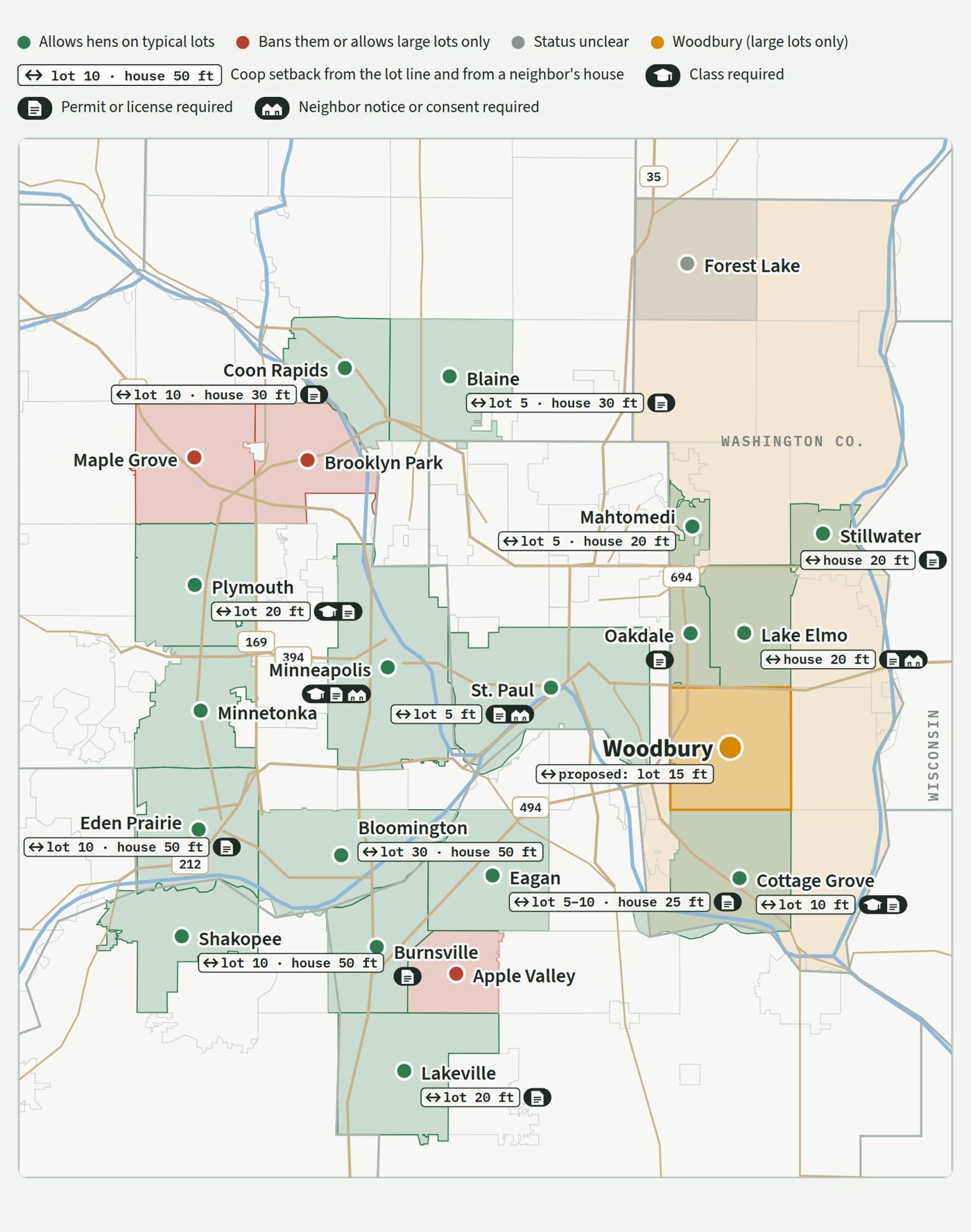
City limits: U.S. Census. Highways and rivers: Natural Earth. Rules from city websites and local news, October 2026.
Open the interactive map →City-by-city details
Everything shown on the map, in one table. "None found" means the city's rules we could read don't mention that requirement. "Not found" means we couldn't find the rule at all.
| City | Hens on typical lots | Coop setback from lot line | Coop setback from neighbor's house | Class | Permit or license | Neighbor notice |
|---|---|---|---|---|---|---|
| Woodbury | ||||||
| WoodburyRear yard. October 7 citywide proposal: 15 ft from lot lines. The 2024 rural R-1/R-2 rule uses 20 ft from lot lines and 50 ft from neighboring homes. | Rural R-1/R-2 lots only (since Oct 2024) | 15 ft proposed 20 ft in 2024 rural rule | 50 ft 2024 rural rule | No | No | No |
| Washington County neighbors | ||||||
| Cottage GroveRear yard, not next to a street. | Allowed | 10 ft | Closer to your home than any neighbor's | Yes: U of M or city-approved poultry course | 2-year permit + inspection | Owner consent if renting |
| Oakdale | Allowed | Not found | Not found | Not found | Police permit | Not found |
| Lake ElmoRear yard. No chickens under 0.5 acre. | Allowed | Not found | 20 ft | None found | $25 permit (under 5 acres) | Mailed notice within 150 ft (2014 draft) |
| StillwaterSetback from 2012 news coverage. | Allowed | Not found | 20 ft | Not found | 2-year permit | Not found |
| Mahtomedi | Allowed | 5 ft | 20 ft | None found | Not found | None found |
| Forest Lake | Unclear | Not found | Not found | Not found | Not found | Not found |
| Other metro cities that allow hens | ||||||
| BlaineRear yard. | Allowed | 5 ft | 30 ft | None found | $45 permit | HOA approval if any |
| BloomingtonRear or side yard; 50 ft from streets; 6 ft privacy fence. | Allowed | 30 ft | 50 ft | None found | Not found | Not found |
| Burnsville | Allowed | Not found | Not found | Not found | 2-year license (2013 info) | Not found |
| Coon RapidsRear yard; 6 ft from own house. | Allowed | 10 ft | 30 ft | None found | Permit | Landlord or HOA consent |
| EaganNot in front yard. 25 ft from any inhabitable building. | Allowed | 10 ft rear, 5 ft side | 25 ft | None found | $50 permit | None found |
| Eden PrairieBack yard. | Allowed | 10 ft | 50 ft | None found | $75 registration + inspection | Not found |
| LakevilleRear yard. Council discussed loosening rules in March 2026. | Allowed | 20 ft | Not found | Not found | $100 one-time permit | Not found |
| Minneapolis | Allowed | Not found | Not found | Yes: approved fowl education course | Permit + inspection | Proof of neighbor consent |
| MinnetonkaNot in front yard. | Allowed | Not found | Not found | None found | None listed | Not found |
| PlymouthRear yard. | Allowed | 20 ft | Not closer to a neighbor's home than your own | Yes: chicken-keeping course | $100 license | Not found |
| ShakopeeBack yard; 4 ft screening. | Allowed | 10 ft | 50 ft | None found | None listed | No notice needed |
| St. PaulRear yard. | Allowed | 5 ft (coop) | Not found | None found | Annual permit + inspection | Written notice to adjacent neighbors (1-6 hens) |
| Outside the metro | ||||||
| Rochester4 ft screening. | Allowed | Not found | 25 ft | None found | Permit approved by council | None found |
| Duluth | Allowed | Not found | 25 ft | None found | Annual license + inspection | None found |
| Metro cities that ban hens or allow large lots only | ||||||
| Apple Valley | Banned (agricultural land only) | Not applicable: no hens on typical lots | ||||
| Brooklyn Park | Only on lots of 5+ acres | Not applicable: no hens on typical lots | ||||
| Maple Grove | Only on lots of 1+ acre | Not applicable: no hens on typical lots | ||||
Woodbury's numbers are its current rule for rural lots. The citywide proposal is Ordinance 2085 (Council Letter 26-196, October 7, 2026), which the council continued. Sources: city codes and permit pages, plus local news where code text wasn't available, gathered October 2026.
Seven Myths, Answered
Noise, smell, disease, predators, property values, looks and neighbors: the seven worries that come up in every hen debate, answered with current facts. Swipe through, or share a page.
Each page has its own link to share. Get the embed code to put this guide on another site.
Open the full guide →Support Residents' Right to Urban Agriculture
Woodbury residents are advocating for the right to raise backyard hens. This initiative seeks to update restrictive zoning codes and allow residents to maintain small flocks for eggs, pest control, and sustainable food security.
Woodbury's ban dates to a 1963 farm-township zoning code that listed chickens alongside cows and pigs. Today, every Washington County neighbor we could confirm (Cottage Grove, Oakdale, Lake Elmo, Stillwater and Mahtomedi) allows hens on ordinary lots.
October 7 update: The City Council held the public hearing on Ordinance 2085 and continued it to a later meeting. The decision is still open, so keep contacting the council.
Initiative Overview
Support residents' right to raise backyard hens and advocate for reasonable urban agriculture regulations.
Learn More →Why Hens Matter
Food security, pest control, sustainability, education, and community building benefits of backyard agriculture.
Discover →Ordinance Status
How the ban started in 1963, the Planning Commission decision, and the path forward to the City Council vote.
Review Status →Take Action
Email the City Council before the item comes back. Share talking points. Make your voice heard on urban agriculture.
Get Involved →⏰ Continued: Ordinance 2085 Is Still Open
On October 7, 2026, the City Council held the public hearing on backyard hens and continued the item to a later meeting.
City staff recommend adopting it: up to 6 hens on single-family lots, coops 15 ft from lot lines and closer to your own home than any neighbor's, a $75 permit with inspections, a state premise ID, and written HOA approval where applicable. The Planning Commission voted 6-1 against it. That vote is advisory, and the closest vote (3-4) was on a version with a 4-hen cap, a 90 sq ft run, and the premise ID.
Our ask: adopt hens on residential lots with the common-sense safeguards nearby cities already use. Ask the council to adopt it when it returns. If they want changes, ask for specific ones rather than a denial or a wait for the 2028 survey.
Initiative Overview
Goal: Support residents' right to raise backyard hens in Woodbury and advocate for reasonable urban agriculture regulations.
Key Issues: Restrictive zoning codes that ban backyard hens, lack of community food security, missed opportunity for sustainable urban gardening.
Status: Ordinance 2085 was continued by the City Council on October 7, 2026. The 2026 city survey found 49% approval, up from 36% in 2024.
Why Backyard Hens Matter
Community benefits include:
- Food Security: Fresh eggs from your own backyard
- Pest Control: Natural management of insects and garden pests
- Sustainability: Reduced food waste through composting and local production
- Education: Kids learn about animal care and food production
- Community Building: Connection between neighbors around shared interests
How the Ban Started, and Where It Stands
Woodbury's restriction on hens wasn't written for today's city. It comes from the township's first zoning code, and no council has voted on whether it fits suburban lots. See the original 1963 newspaper records →
- August 26, 1963. The Town Board of the Township of Woodbury adopts Ordinance No. 50, its first zoning code. It defines chickens as farm animals, alongside horses, cows, sheep and pigs, and requires at least 3 acres for any lot with farm animals. R-4 house lots were already 10,000 square feet.
- 2010. After complaints about two roosters in Carriage Farms, staff say the existing rules already bar poultry from urban areas but the wording is unclear. In September, the council votes 5-0 to clarify that chickens are not pets. Hens on house lots are not debated.
- October 23, 2024. Hens allowed in the rural R-1 and R-2 zones only (up to 6, coop 20 ft from lot lines and 50 ft from neighboring homes). Typical R-4 lots stay excluded.
- 2026. The council asks staff to explore hens citywide. Staff recommends an ordinance.
- September 28, 2026. The Planning Commission votes 6-1 to recommend against, and to revisit after the 2028 survey. The version with a 4-hen cap, a 90 sq ft run and a state premise ID fails 3-4. The vote is advisory.
- October 7, 2026. City Council holds the public hearing on Ordinance 2085 (up to 6 hens, coops 15 ft from lot lines) and continues the item to a later meeting.
- Next. The ordinance returns to the council. Date to be announced.
Proposed Safeguards: Answers Other Cities Already Use
Every common concern has a tested answer in a nearby city. See the city-by-city details above.
| Concern | Safeguard | Already used in |
|---|---|---|
| Noise | Hens only; no roosters. The 2010 complaints were about roosters. | Nearly every metro city that allows hens |
| Too many birds | Cap of 4 to 6 hens per home | Bloomington and Eden Prairie (4), Eagan (5), Plymouth, Blaine and Cottage Grove (6) |
| Too close to neighbors | Rear-yard coop with setbacks from lot lines and neighboring homes. The October 7 proposal uses 15 ft from lot lines. | Woodbury's own 2024 rule (50 ft from neighboring homes), Bloomington, Eden Prairie, Shakopee |
| Oversight and enforcement | Permit or registration, revocable for violations | Eagan, Blaine, Plymouth, Lakeville, Cottage Grove, St. Paul |
| Bird flu | Registration so the city and health officials know where flocks are | The 4-hen version the Planning Commission nearly passed |
| Inexperienced keepers | Optional class requirement | Cottage Grove, Plymouth, Minneapolis |
| Smell and rodents | Enclosed coop, sanitation rules, no free-ranging | Blaine, Eagan, Shakopee |
| "Next it'll be goats" | The ordinance names hens only; nothing else changes. | – |
| HOA rules | HOA covenants still apply | Blaine requires HOA sign-off |
Take Action Now: Before the Ordinance Returns
The council continued Ordinance 2085 on October 7, 2026. It will come back. Here's what you can do now:
1. Email City Council
Send your message to: [email protected]. Keep it short, say you're a Woodbury resident, and add one personal reason. Linking the metro hen map and the 1963 history helps.
2. Attend City Council Meeting
Watch the agenda at woodburymn.gov and show up when Ordinance 2085 returns. Council meetings are usually Wednesdays at 7:30 PM at City Hall.
3. Talk to Your Councilmember
A short, friendly note or call from a constituent goes a long way. Ask: "What would you need to see to vote yes?"
4. Check the Agenda
When the item is back on the agenda, check whether it's a public hearing (fill out a green sheet) or a regular item. If it isn't open for comment, email the council beforehand. Open Forum is for topics that aren't on the agenda.
Key Messages
Please keep it friendly and focused on the facts. Respectful, specific comments persuade best.
Resources & Information
Facebook Community Group - Connect with neighbors and stay updated
Where the Ban Came From (1963) - Original newspaper records from the Minnesota Historical Society
Seven Chicken Myths, Answered - A swipeable guide to the most common concerns, with sources
Interactive Metro Hen Map - Rules, setbacks and requirements city by city